Clair leaning in across a consultation table, hands open

She said she would think about it. You still do not know what happened.

For aesthetic clinic owners who hear “I’ll think about it” more often than “let’s start.”

Objection Mastery teaches you to identify the objection underneath the sentence, so you know what to ask, when to stay silent, and what not to explain.

Show me what she is really saying
Sunday.A lead comes in, and something in you says maybe this one.
An hour before.You set the room. You are actually looking forward to it.
In the room.It is going well. She is nodding. She asks good questions.
The price.Your heartbeat changes.
“I’ll think about it.”She smiles. She thanks you. Good night.
Two hours later.Nothing.
The next day.Nothing.
A week later.You already know.

You tell yourself it was not the right client. But part of you still wonders what you did wrong.

  • Without reciting someone else’s lines.

  • Without pushing, chasing, or dropping your price to close.

  • Without becoming someone you are not in your own treatment room.

  • Without guessing why one client booked and the next one walked.

You did not open a clinic to become good at selling

You opened it to be good at the work, and to have a life outside it.

You did not work this hard to feel small in the one room where you should feel most certain.

What it is for

  • A month that ends without the arithmetic.
  • Sleeping through the week the payments are due.
  • Saying yes to dinner, a trip, or a day away without calculating what has to be cancelled instead.
  • Taking time off without spending it wondering what the clinic is losing.
  • None of that requires a bigger clinic. It requires more of the right women who already walked through your door leaving with enough clarity to make a decision.
Built by Clair after more than 24,600 consultations across twenty-six years in aesthetic clinics. Every part of the method came out of that room, not out of a sales book.
Clair
Clair standing quietly, one hand resting at her chest

The sentence is not the objection.

She says: “I need to think about it.”

You could explain the treatment again. You could remind her why she came. You could offer to call next week.

None of those tells you what she needs to think about.

Is she unsure about the result? Afraid of choosing wrong? Unable to justify the amount this month? Waiting for someone else’s approval? Or quietly certain this is not the right treatment for her?

Five different conversations. The same sentence.

And it is not one consultation.

Ten hours in the clinic. Five new inquiries. Three consultations. Not one of them closed.

By the third one, you are no longer listening only to her. You are also listening to the last two conversations in your head.

I remember exactly how I used to walk into consultations. I was nervous, worried, always thinking about what else to say so the client would agree. Maybe offer another discount? Maybe try to convince her a little harder?
Svetlana Y., Esthetician, 20+ Years
Clinic paperwork spread across a desk at the end of a day

The week it lands

Some months your team takes home more than you do.

In your own clinic.

Then comes the week everything lands at once. Payroll, suppliers, the tax bill. You open the account and you already know the number is short, because this month did not close enough.

And it does not stay in the clinic. It is there at dinner while you are checking your phone, and it is there at eleven at night when you are still working out where you lost her.

When the same uncertainty repeats across five consultations, it stops being one uncomfortable conversation. It becomes a pattern in the business.

“It’s expensive” does not tell you what the problem is.

It may be the amount. It may be the timing. It may be uncertainty about the result, or fear of choosing the wrong treatment. It may be the first safe sentence she found when she could not say what was holding her back.

She may have been serious when she booked. She may still want the treatment.

She did not necessarily reject the treatment. She left with something unresolved.

From the consultation room

Four conversations, and what each one taught me.

A consultation I still remember

She said

Can you do it a little cheaper?

What I did

I said yes too fast, and took money off on the spot.

What happened

She booked, then quietly canceled a week later.

What I learned

A discount you give the moment you’re asked teaches the client the price was never real.

Early in my career

She said

Just send me the prices and I’ll get back to you.

What I did

I didn’t email a number. I asked one question that kept her in the room.

Before I send the prices, can I ask what result you’re hoping for?

What happened

She started describing what she actually wanted. The price stopped being the whole conversation.

The lesson

A price sent by email is a decision made alone. Keep the decision in the room.

Years later

She said

I’m not sure now is the right time.

What I did

I didn’t invent a deadline. I asked what would make it feel right.

What happened

The real hesitation came out. She was worried about the recovery, not the calendar.

The lesson

Timing is rarely about the calendar. It’s about certainty.

One afternoon

She said

I saw it cheaper somewhere else.

What I did

I didn’t defend my price or say a word about the other clinic. I asked:

That’s worth looking at. Can I ask what matters most to you in who does this?

What happened

She thought about it, and realized price wasn’t actually her first concern. Feeling safe was.

The lesson

Compete on price and you lose the one thing that makes you the safe choice.

Consultation examples are based on real conversations. Names and identifying details have been changed to protect client privacy.

When a client said “I need to think about it,” I’d give her a discount. Now I ask the right questions, and within minutes she makes the decision and books her treatment.
Liora O., Clinic Group Owner

This is not a discipline problem and it is not a personality problem.
And it is not a verdict on whether you are any good at this.

It is not the leads. And it is not you. It is a pattern nobody ever showed you how to see.

An objection is not resistance. It is often the moment the real decision finally enters the room.

We do not answer objections. We uncover them.

Safety 1

Lower the pressure

Lower the pressure, so she can tell you what is holding her back.

Understanding 2

Listen past the sentence

Separate the words she used from the concern underneath them.

Clarity 3

Draw it out

Ask the question that brings the real decision into the room.

Commitment 4

Let her decide

Help her reach a clear yes, a clear no, or a clear next step, rather than a decision she was talked into.

Years ago I sat across from a woman named Rachel. She told me no four or five times in one consultation. First the price. Then the timing. Then whether she could commit at all.

Halfway through, something clicked. Every objection told me she was still trying to resolve something. An objection does not always mean she is ready to buy. It means there may still be something in the conversation worth understanding.

By the end she laughed and said she had spent the last twenty minutes talking herself into it.

A pattern you can see is a pattern you can change.

In the room

What this sounds like in the room

She says

I need to think about it.

The usual response is to explain more, defend the price, or ask when to follow up.

The CAREPLAIN response starts one step earlier:

Of course. Before you go, what still feels unclear?

She still gets to think. You just get to hear what about, while she is still in the room.

In the consultation room, I’m not on a mission to convince anymore. The sale moves in stages, and when I miss the order, I can see the difference.
Yvette G., Owner of Two Aesthetic Clinics

Which one did you hear this week?

Each of these sentences can hide more than one concern.

Treat the sentence as the objection, and you may answer something she was not asking.

This week

  • “I’ll think about it.”
  • “I need to talk to my husband.”
  • “It’s expensive for me right now.”
  • “Get back to me in a month.”
  • “I want to check a few other places.”
Every consultant in this field hears these sentences. The difference is not whether they appear. It is what happens in the ten seconds after.
Clair
A client leaving through the clinic door while the practitioner watches from the desk

Five rules nobody wrote down

You did not choose these. They came with the profession.

I am a practitioner. Selling is somebody else’s job.

If the treatment is good enough, it should sell itself.

If she says it is expensive, there is nothing more to discuss.

Asking another question would make me pushy.

If she really wants it, she will come back on her own.

Every one of them protects the part of you that got into this work to take care of people.

And every one of them can close a conversation before the real concern has been heard.

I thought sales was a talent. You either have it or you don’t. Today I know there’s a method.
Liora O., Clinic Group Owner

I am Clair.

Clair standing on a terrace, hands clasped, looking directly at the camera

I once lost a client I had already won. Not in the room. At home, nine in the evening, sure the work was done.

Her name was Sofia. She closed a beautiful package, walked out happy, and I felt like I had won.

What I did not see was what happened in the hours after. On the drive home the number began to feel bigger. At home, someone questioned it. By morning the certainty she had left with was gone. “I am so sorry. I do not think I can.”

I did not lose her that morning. I lost her the evening before, the moment I decided the work was finished.

Weeks later a nearly identical woman sat across from me. This time, the second she said yes, I stopped. Before she left we talked about what happens once she is alone with a decision, and we named the doubts before they had a chance to surprise her. Then I sent her everything we had agreed, before she reached home.

That evening the doubt came for her too. She was ready for it. She came in for her first treatment and stayed with me for years.

The difference was not in the room. It was in the minutes after.

Clinic owners who learned this method

Liora O.Clinic Group Owner

Svetlana Y.Esthetician, 20+ Years

These are individual experiences shared in the women’s own words. Results are not typical and depend on your clinic, your market and how you apply the method. CAREPLAIN does not promise a specific business outcome.

OBJECTION MASTERY

A complete objection-handling system, built for the aesthetic consultation room.

Without a method, every consultation becomes a new test of whether you happen to say the right thing.

The program

  • Recognition. Tell the difference between a real objection, a polite exit, and a concern she has not yet found words for.
  • The seven types. Identify which kind of objection is in front of you before you choose a response.
  • The twelve conversations. The objections aesthetic clinic owners hear most. Price, timing, partner approval, comparison shopping, and “I’ll think about it.”
  • The ten seconds. What to ask, what not to say, when to stay silent, and how to stop yourself from explaining more.
  • Decision security. Build enough clarity that the decision does not depend on the emotion of the moment.
  • Follow-up. Continue the conversation without chasing and without another “just checking in.”

Fifteen focused sessions, plus the two practical additions below. Four hours in total. Most run under fifteen minutes; the longest, the six live dialogues, runs twenty-three.

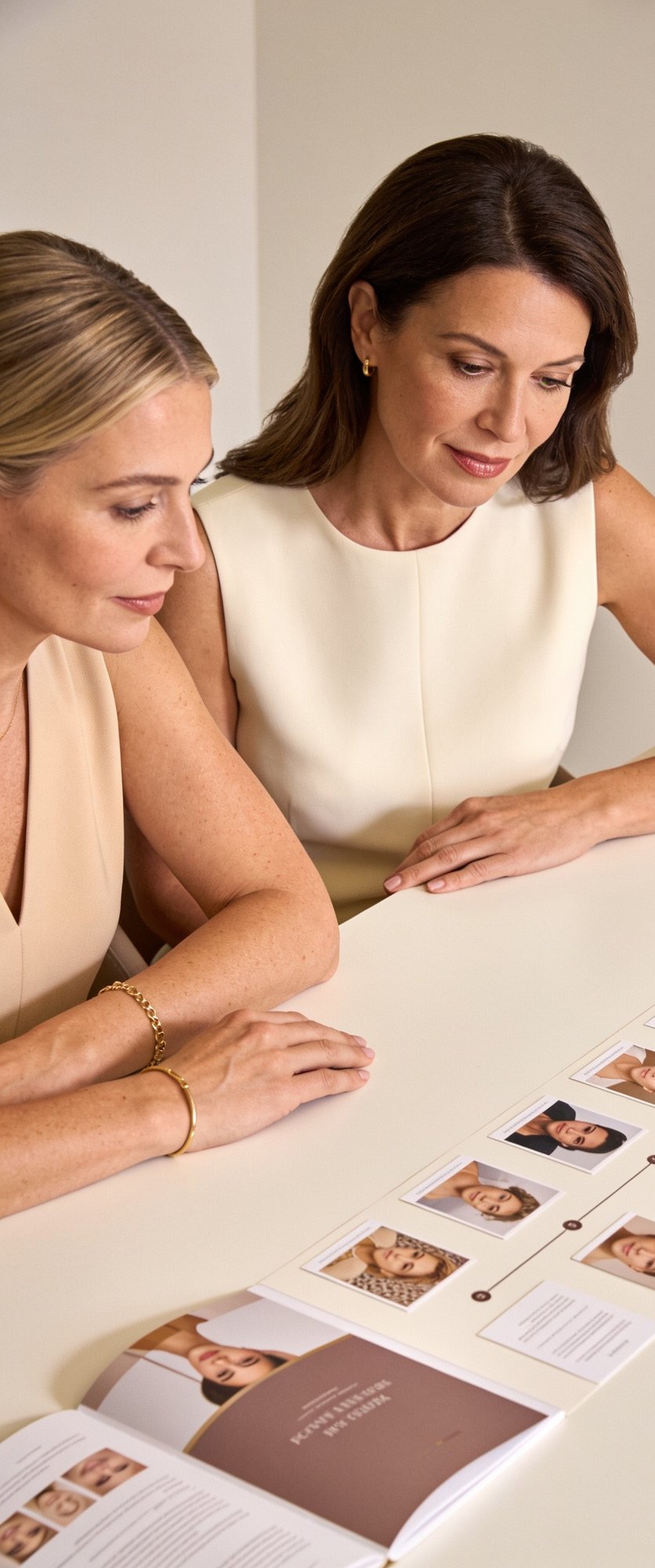
Two women at a table, leaning over a printed treatment sequence together

Hear one, before you decide

Session two, in full. It opens with two women who sat across from me in the same week and said the exact same three words about the exact same treatment. Only one of them came back.

No email. No sign-up. Twelve and a half minutes, and it is one of fifteen.

What you receive

  • The Implementation Workbook. A four-week plan, plus an exercise for every chapter. Week one is silence. Week two, response practice. Week three, identification. Week four, integration. Inside it, two pages you will keep using long after: the consultation log you fill in after a meeting, and the starter page where you write each response in words that sound like you.

  • The Objection Playbook. The twelve objections, each with its likely type, the first question to ask, and finished language you can adapt into your own voice. Built for the minute before a consultation.

  • Six live conversations. Six consultations, start to finish. Each one stops at the moment it could have gone two ways. Watch the same consultation continue in both directions, and see the exact point where the outcome changes.

  • Objections in writing. The same method in a message thread, where more of the conversation now happens. What changes when there is no silence to hold and no face to read.

How access works

Objection Mastery is a self-paced video program inside your private learning portal. Every session includes English captions.

Watch from your phone, tablet or computer, and return to any session whenever you need it. The Implementation Workbook and the Objection Playbook are included as downloadable PDFs, so you can print them or keep them open during a consultation.

Access begins immediately after purchase.

What changes

You walk into the next consultation knowing what to listen for, instead of guessing what to say.

You state your price and let it stand. No discount before she asks. No apology after.

You notice the moment a concern appears, even when she has not named it.

And you stop leaving the room with no idea what happened.

You stop carrying every unfinished consultation into the evening.

You stop measuring next month by how many new leads you can afford.

You make decisions from stability instead of urgency.

And the business begins to give something back to the life that built it.

More money was never the point. The point is what it lets you stop worrying about, and what it lets you start saying yes to.


I walk in confident, without a trace of fear. My clients feel it.
Yvette G., Owner of Two Aesthetic Clinics

Enroll

One system. Every consultation. Every treatment category.

Compare $797 with the value of one treatment plan in your clinic. You already know the number.

Objection Mastery

$797

One payment, not a subscription. Taxes may apply and are calculated at checkout.

Built from more than 24,600 real consultations. Not sales theory.

  • Fifteen focused sessions, four hours in total
  • The Implementation Workbook, a four-week plan with an exercise per chapter
  • The Objection Playbook, the twelve objections and the first question for each
  • Six live conversations, each shown continuing both ways
  • Objections in writing, for the thread where the conversation now happens
  • Lifetime access to Objection Mastery and future updates to the material it includes

Enrollment opens in September.

Take the Pattern Check

Leave your email with the Pattern Check and you will hear first when doors open.

Thirty days

Use it in real consultations. If within thirty days it has not given you a clearer way to recognize and respond to what she is objecting to, email me and I will return every dollar.

No forms. No questions.

I can honestly say the program paid for itself. And more than that, it lifted my clinic to a profitable, secure place.
Liora O., Clinic Group OwnerAn individual experience, in her own words. Results are not typical and depend on your clinic, your market and how you apply the method.
This is not for you if
  • You want a line that pressures any client into buying.
  • You are not currently running real consultations.
  • You want scripts to repeat without learning to read the conversation.
This is for you if
  • You are strong in the treatment room and less certain in the consultation room.
  • You want to understand objections before you answer them.
  • You want a clear method that still sounds like you.

Before you decide

I have taken sales programs before and nothing changed.

Most teach you what to say. This starts one step earlier, with what she meant. A response you understand survives a conversation that goes off script. A memorized one does not.

I do not want to be pushy. That is exactly why I avoid this.

Pushing is what happens when you do not know what she is weighing, so you apply pressure instead. Here you will ask more and say less.

I am a practitioner, not a salesperson.

You are, and nobody is asking you to become one. Leading a consultation is part of taking care of her. A woman who leaves confused was not served well, however good the treatment would have been.

I do not have time for this right now.

Most sessions run under fifteen minutes. Take one before your first consultation and use it that morning.

How long do I have access?

Lifetime access to the program and to future updates of the material it includes.

The business was supposed to support your life. Not follow you home every night.

You already know how to care for the client once she says yes.

This is how you care for the decision before she does.

Clair

A notebook open on a clinic desk

Not ready to decide?

Start with the free Pattern Check

Your last five consultations, and the ending that keeps repeating.

Your last five consultations, and the ending that keeps repeating.

Your last five consultations, and the ending that keeps repeating.

Take the Pattern Check